
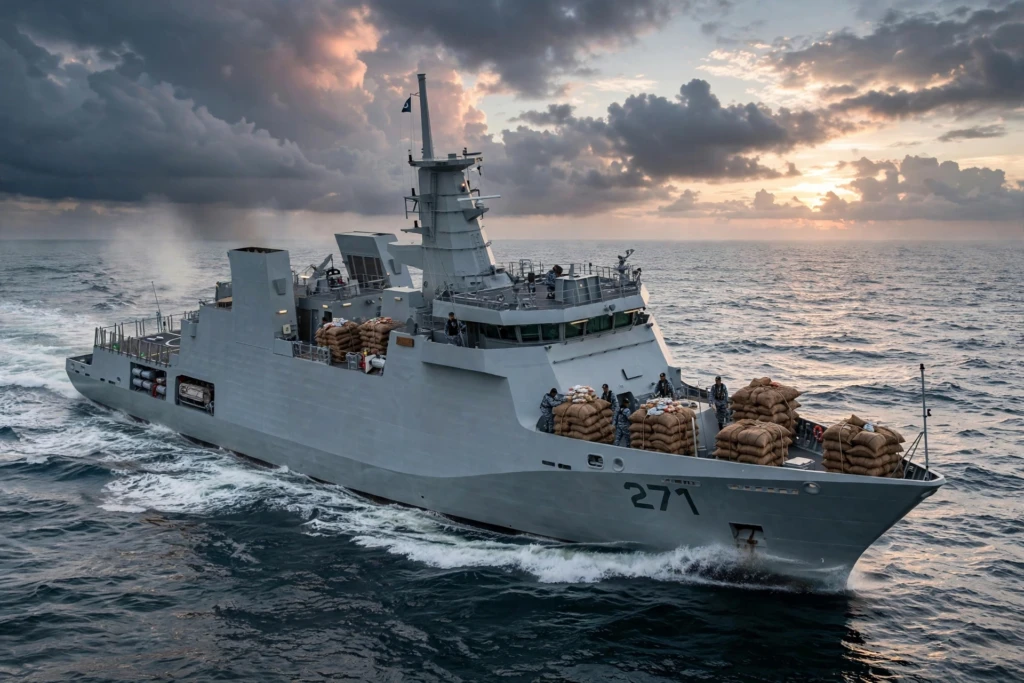
In one of the largest maritime counter-narcotics actions in recent memory, the Pakistan Navy narcotics seizure in the Arabian Sea has struck a major blow against international drug trafficking networks, with officials valuing the confiscated contraband at a staggering $750 million. The high-seas operation is being described by naval authorities as the result of weeks of intelligence gathering, surveillance and carefully coordinated patrols across one of the world’s busiest smuggling corridors.
According to details shared by naval officials, the interception took place after suspicious vessel movements were tracked through the Navy’s maritime surveillance network. A Pakistan Navy ship closed in on the target vessel, boarded it, and discovered a massive cache of narcotics concealed on board. The crew was detained and the contraband seized for further legal proceedings.
Inside the Arabian Sea Operation
Maritime interdiction operations of this scale are complex undertakings. They typically begin with intelligence — tip-offs, satellite imagery, or patterns spotted by patrol aircraft — long before a warship ever sets course toward a suspect vessel. In this case, officials say the operation unfolded over several days as naval units maintained discreet contact with the target before moving in.
Boarding a vessel on the open ocean is one of the most demanding tasks a navy performs. Specialist teams approach in fast boats, secure the ship, and conduct a systematic search while the crew is mustered and questioned. The Pakistan Navy has steadily built this capability over the years, and the $750 million seizure demonstrates how far that expertise has come.
Officials have not yet released the exact quantity or type of narcotics recovered, but the estimated value suggests an enormous volume — likely measured in tonnes rather than kilograms. Samples will be sent for forensic analysis as part of the investigation.
Pakistan Navy Narcotics Seizure: The Scale of the $750 Million Haul
To put the figure in perspective, a $750 million narcotics seizure ranks among the largest ever made by Pakistani forces at sea. Such hauls represent not just drugs kept off the streets, but a devastating financial hit to the criminal syndicates behind them. Trafficking organisations invest heavily in each shipment — the vessel, the crew, the logistics — and losing a cargo of this value can cripple a network’s operations for months.
Pakistan Navy’s Expanding Anti-Narcotics Role
While the Pakistan Navy’s primary mission is the defence of the country’s maritime frontiers, counter-narcotics has become an increasingly important part of its portfolio. Pakistan sits at the crossroads of some of the world’s most active drug trafficking routes, and its long coastline and vast exclusive economic zone make maritime smuggling an attractive option for traffickers.
In recent years, the Navy has worked alongside the Anti-Narcotics Force, the Maritime Security Agency and international partners to choke off the sea routes used by smugglers. Joint patrols, information sharing and coordinated operations with regional navies have all contributed to a string of successful interdictions.
Naval officials say the latest operation reflects a deliberate strategy: pushing interdiction efforts further out to sea, intercepting shipments before they can reach transshipment points or final destinations.
The Regional Drug Trafficking Context
The Arabian Sea has long been a favoured highway for drug traffickers moving narcotics out of the Golden Crescent — the region spanning parts of Afghanistan, Iran and Pakistan that remains one of the world’s largest sources of opiates. From there, consignments are typically loaded onto dhows and fishing vessels that blend into the dense maritime traffic of the northern Indian Ocean.
Traffickers favour the sea route because a single dhow can carry tonnes of contraband, far more than any overland convoy, and the vastness of the ocean makes detection difficult. Shipments are often destined for the Gulf states, East Africa and onward to Europe, with each leg of the journey handled by a different criminal group.
International naval coalitions and regional task forces have had some success against these networks, but the trade is enormously profitable and traffickers adapt quickly — changing routes, using new vessels and exploiting gaps in surveillance. Operations like this one are a reminder that the battle is far from over.
What Happens Next
The seized narcotics will now become the centrepiece of a criminal investigation. Authorities will work to trace the shipment back to its source, identify the networks involved and bring those responsible to justice. The detained crew members are expected to face charges under Pakistan’s narcotics laws, which carry severe penalties.
Beyond the immediate legal process, the operation sends a clear message to trafficking organisations: the Arabian Sea is being watched. For the Pakistan Navy, the $750 million seizure is both a milestone and a motivation — proof that sustained investment in maritime surveillance and interdiction is paying off, and a reminder of how much work remains to be done.



Comments (0)
Be respectful — comments are moderated.