
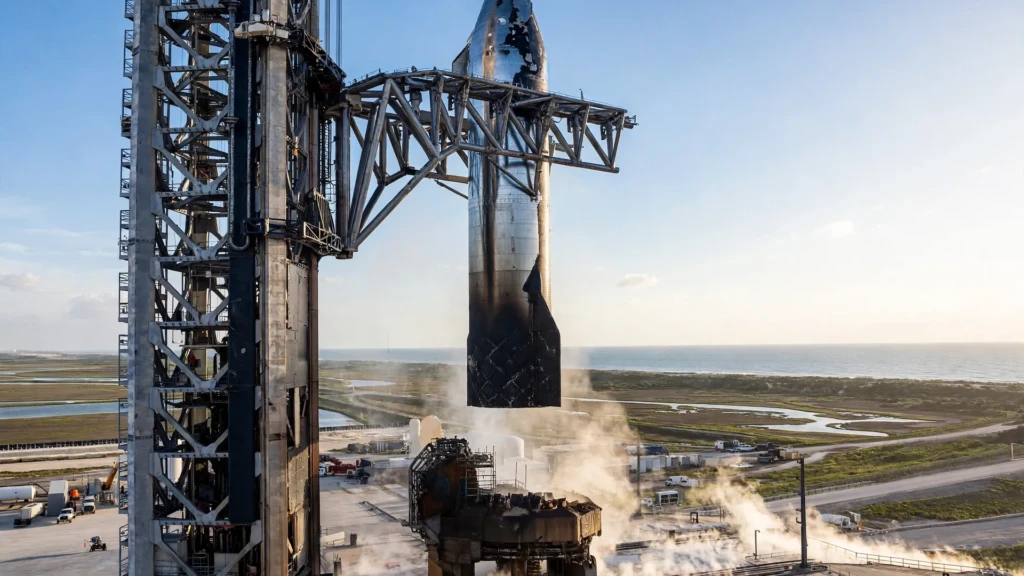
SpaceX has caught its Starship spacecraft with the launch tower’s giant arms for the first time. The upper stage, known as Ship 42, returned to Starbase in Texas on Saturday afternoon after about 22 hours in orbit. It is the first time a tower has ever caught the top half of the rocket.
The catch came at about 4:20 p.m. ET on Saturday, 14 November. It was the key moment of Starship’s 15th full-scale test flight, and only its second trip to orbit. The same flight lost its Super Heavy booster, which was destroyed over the Gulf of Mexico.
How the catch happened
Starship lifted off from Starbase, Texas, on Friday afternoon, 13 November, at 5:47 p.m. EST. The full rocket stands 407 feet (124 metres) tall, making it the largest and most powerful rocket ever flown. After separating from its booster, the Ship reached orbit and released 26 Starlink V3 internet satellites.
The Ship then circled the Earth 14 times at about 165 miles (265 kilometres) up. That is far more than the one or two laps of the previous mission. Live views of the spacecraft and the Earth streamed down via Starlink during the flight.
For the return, the Ship fell back through the atmosphere over northern Mexico and South Texas. It flew in flat, belly-first, until the last moment. Then it flipped upright on three Raptor engines and came in for a controlled catch. The landing burn started at T+22 hours, 32 minutes and 16 seconds. Eighteen seconds later, the tower’s two arms snapped shut around the catch fittings, which sit just below the forward flaps near the nose. The Ship sensed the touch and cut its last engine.
The stainless steel spacecraft, 171 feet tall and 29.5 feet wide, then hung high above the ground, supported by the arms of the launch tower. Cameras panned the spacecraft up and down as it hung there. SpaceX said the Ship’s systems, including its heat shield, appeared to work well during the long flight. The Ship’s condition after the catch has not been reported yet.
The booster was lost
The flight had aimed for a first double catch: the Super Heavy booster first, then the Ship a day later. Only the Ship made it back to the tower. The booster, a new Super Heavy V3 known as Booster 22, aborted its own return shortly after launch.
SpaceX’s Kate Tice said the booster’s engines shut down too early during the descent. Its guidance system sensed it was not in the right position and diverted it to the Gulf of Mexico, where the flight termination system was triggered. The booster was destroyed over the water. Wreckage remained in the Gulf, cordoned off by buoys. Elon Musk said the booster had run low on fuel, but engineers are still investigating the exact cause.
Whether the FAA will require a mishap investigation has not been reported. US Flight Ground Stop Explained: Why the FAA Halted Flights looks at how the FAA handled a very different aviation failure this week. SpaceX had already caught boosters on three previous Starship flights, so the technique itself is proven. Fixing the booster is now the missing half of the plan.
Why the catch matters
The catch is a major step towards SpaceX’s goal of a fully reusable rocket. If both halves of Starship can be caught and flown again, spaceflight becomes far cheaper. That matters for the company’s plans to send people to the Moon and Mars.
Flight 15 was the fourth launch of Starship V3, a radically different design from the first two versions of the rocket. The Ship’s long flight, with 14 laps of Earth and a satellite delivery, tested far more of the spacecraft’s systems than any earlier mission.
SpaceX now expects to begin launching Starships from Florida’s Kennedy Space Center within the next few months. The company will also need to show it can catch a booster and a Ship on the same flight, and then fly a caught Ship again, before the system works like an aircraft.
Read more of our Technology coverage.
Sources: USA Today, Economic Times, The Verge, CNBC, SpaceX flight timeline.




Comments (0)
Be respectful — comments are moderated.