
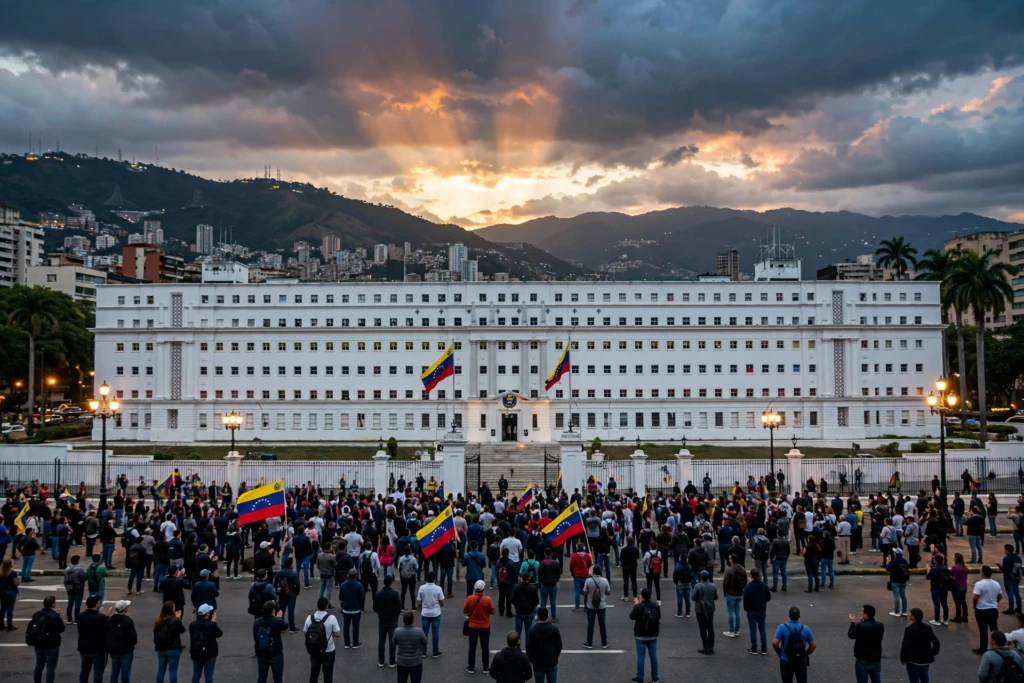
In a day of extraordinary political drama, Venezuela Delcy Rodriguez interim president became a reality as the longtime vice president was sworn in to lead the country, hours after the United States seized Nicolas Maduro in a stunning operation. The rapid transfer of power — endorsed by parliament but denounced by protesters in the streets — has plunged Venezuela into one of the most turbulent chapters in its modern history.
The events unfolded with breathtaking speed. News of Maduro’s seizure spread across the globe within hours, followed by his defiant court appearance in New York, Rodriguez’s swearing-in ceremony in Caracas, and demonstrations both for and against the unfolding power shift. Few days in recent Latin American history have packed in so much consequence.
The Stunning Seizure of Nicolas Maduro
Details of how American forces seized the Venezuelan leader remain closely guarded, but the outcome is undeniable: Nicolas Maduro, who ruled Venezuela for over a decade, is now in United States custody. The operation represents an unprecedented escalation in Washington’s long-running confrontation with the Maduro government.
For years, the United States has refused to recognise Maduro’s legitimacy, backing opposition figures and imposing sweeping sanctions on Venezuela’s oil-dependent economy. The decision to move from pressure to direct seizure marks a dramatic break with precedent — and raises profound questions about sovereignty and international law.
Supporters of the operation argue that Maduro’s rule was illegitimate and repressive, pointing to disputed elections, human rights abuses and economic collapse. Critics counter that forcibly removing a sitting head of state sets a dangerous global precedent, regardless of one’s view of his government.
Maduro Pleads Not Guilty in New York Court
Within hours of his seizure, Maduro appeared before a federal court in New York, where he pleaded not guilty to drug trafficking charges brought by American prosecutors. The image of a once-powerful president standing as a defendant in a foreign courtroom was, for many Venezuelans, almost surreal.
US authorities have long accused Maduro and senior figures in his government of involvement in narcotics trafficking, allegations Caracas has always dismissed as politically motivated fabrications. The court case will now test those claims under the harsh light of the American legal system.
Maduro’s legal team signalled a vigorous defence, challenging both the charges and the legality of his seizure. The proceedings are expected to be lengthy, closely watched and politically explosive at every stage.
Venezuela Delcy Rodriguez Interim President: Parliament’s Backing
Back in Caracas, the political machinery moved swiftly. Parliament backed Delcy Rodriguez — Maduro’s vice president and one of the most powerful figures in the government — as interim president, and she was sworn in before assembled officials in a ceremony heavy with symbolism.
Rodriguez is no newcomer to power. As vice president, she was the public face of the government’s economic management and a key interlocutor with foreign powers. Her elevation provides continuity for the ruling establishment — which is precisely why the opposition views it with deep suspicion.
In her first remarks, Rodriguez struck a defiant tone, vowing to defend Venezuela’s sovereignty and condemning Maduro’s seizure. Whether she can stabilise a country in shock — and whether she intends to hold elections or entrench the existing order — are the questions that will define her interim tenure.
Protests Erupt Across Venezuela
The streets told their own story. Protests erupted in Caracas and other cities, with demonstrators divided between those celebrating Maduro’s downfall and those denouncing what they see as a foreign intervention against their country. Security forces deployed heavily, and scattered clashes were reported.
Venezuela’s opposition, long suppressed, sensed an opening — but also faces the reality that the state apparatus, now led by Rodriguez, remains firmly in the hands of Maduro’s allies. The coming days will test whether the opposition can convert this moment into genuine political change.
Ordinary Venezuelans, exhausted by years of economic crisis and mass emigration, watched events unfold with a mixture of hope, fear and disbelief. For a nation that has endured so much, the question is whether this upheaval brings relief or simply a new chapter of instability.
International Reactions and What Happens Next
Around the world, reactions split along familiar lines. Governments allied with Washington welcomed the move against Maduro; others condemned the seizure as a violation of international law and warned of destabilising consequences for the region.
What happens next is deeply uncertain. Will Rodriguez steer Venezuela toward elections, or consolidate power? Will the United States ease sanctions or tighten its grip? And will the Venezuelan military — the ultimate arbiter of power in Caracas — remain loyal to the new interim president? The answers will shape not just Venezuela’s future, but the wider geopolitics of the Americas.
Comments (0)
Be respectful — comments are moderated.